

or
 Continue with Facebook
Looking to list your Masters courses? Log in here.

If you have questions about the process of applying for a Masters, Google will often be your first port of call (unless you’re part of the plucky 4.42% that use Bing). You’ll probably also be familiar with the weird and wonderful suggestions presented by Google’s autocomplete function (see the screenshot below if you’re not sure what we mean).
Well, we’ve taken it upon ourselves to dive down the algorithmic rabbit hole and explore some of the pressing issues Google thinks people like you are interested in. Join us as we ponder the motivations of the Great Anonymous Internet Public.
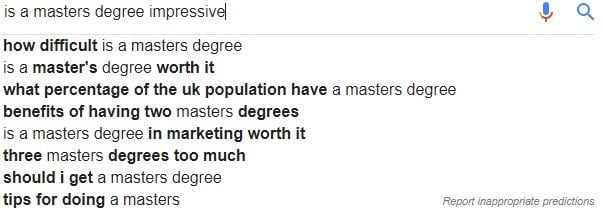
This is actually a very good question, and one that is somewhat difficult to answer. To the best of our knowledge, there isn’t an official record of how many people in the UK have Masters (or another postgraduate qualification).
According to the Office for National Statistics, 42% of the UK population between the ages of 21 and 64 were university graduates in July 2017. This amounts to around 14.28 million people in that age category with degrees.
We can combine this figure with the latest numbers from the Higher Education Statistics Agency (HESA) to give a rough (and possibly incorrect) idea of how many people in the UK have a Masters. HESA say that out of the 703,515 students who received an undergraduate degree or postgraduate qualification in 2017-18, 183,500 had studied a taught Masters. This means that 26% of graduates in 2017-18 were taught Masters students.
If we extrapolate this figure to the 42% of the UK’s population aged between 21 and 64 that have a degree, we find that around 6.2% of this age category have a Masters degree (885,360 people). As a percentage of the UK’s total population in 2017 (including babies, current university students, pensioners and everyone else) of 66,040,200, this means that Masters graduates form 1.3% of the population.
Of course, there are all kinds of caveats to this percentage and we don’t endorse its accuracy. It is napkin maths performed by an English Literature graduate with no background in statistics whatsoever. But it hopefully gives you a ballpark figure to ponder.
Physically? No, probably not. Unless you count the possibility of paper cuts from your degree certificate. Of course, there are certain Masters programmes that might be a bit more hazardous than others (Pollution Control, Parasitology and Petrochemical Chemistry, with something like Poultry Keeping a little further down the pecking order). But you can rest assured that universities will adhere to the highest health and safety standards – there’s even a Masters for that. . .
In all seriousness, it’s unlikely that a Masters will ‘hurt’ you in terms of your career. While a Masters isn’t a guarantee that you’ll walk into your dream job, statistics certainly point towards the conclusion that people with postgraduate qualifications tend to earn more than those without.
This is probably the sort of question you should be asking yourself rather than a search engine.
We have written a page on some of the reasons to study a Masters, which might be useful if you’re struggling to understand your own motivations.
It depends on the size and design of the frame that you use to display it proudly above your mantelpiece. If you choose a tacky £2 picture frame from your local charity shop to present your degree certificate in, it probably won’t leave much of an impression on houseguests.
If, on the other hand, you opt for an elegant, custom-made gold-leaf frame from your local artisan, you are more likely to earn respect from your peers, rivals and family members. For bonus points, position it alongside your Grade 3 Trombone and swimming certificates.
Much like the length of a piece of a string, the ‘difficulty’ of a Masters is impossible to define, which probably isn’t the answer our anonymous Googler was looking for.
While the step from undergraduate to postgraduate study is a significant one, it might not be as sizeable as you’d think. Most Masters build on existing skills and knowledge, introducing more advanced concepts and placing a greater emphasis on independent learning. Our advice would be not to let yourself feel intimidated by the prospect of a Masters, instead seeing it as a welcome opportunity to challenge yourself.
Almost certainly.
Cheesy as it sounds, one of the best ways to ‘survive’ a Masters is not to view it as some terrible ordeal that you need to survive. We can’t emphasise this enough: studying a Masters is not akin to enduring a shark attack or an episode of Mrs Brown’s Boys (to be perfectly honest, I’d rather face a shark than an evening with the irrepressible Mrs Brown).
No, a Masters degree should be something that feels worthwhile. It won’t necessarily be easy (nothing worthwhile ever is), but if you’re studying a Masters for the right reasons it won’t feel like an awful trial. Trust us.

Browse over 20,000 Masters courses on FindAMasters today.
Our free newsletter provides regular postgrad study information, advice and news.

The value of studying an Arts & Humanities Masters
What key skills and experiences can you expect to gain from a postgraduate course in subjects like English, History and Philosophy?

5 important differences between undergraduate and postgraduate study
We’ve listed a handful of the ways that signal where your undergraduate course ends and the Masters begins.

Moving for a Masters – postgraduate study at a new university
Considering switching university for your postgraduate degree? Here's what to consider as you make the decision.

or
Continue with Facebook


We've been helping students find the right postgraduate course for over a decade.