




FREE online Masters study webinar - NEXT WEEK! | REGISTER NOW FREE online Masters study webinar - NEXT WEEK! | REGISTER NOW
Full time September MSc 1 year full time
Chemistry (6) Engineering (12) Environmental Sciences (13) Materials Science (24) Physics (29)

About the course

Register your interest in graduate study at UCL

The global challenges of climate and energy require new technologies for renewable energy sources, methods of energy storage, efficient energy use, techniques for carbon capture and storage, climate engineering, as well as an appreciation of the impact of these on the environment. This is a broad-based MSc, ideal for you if you wish to acquire skills in energy and materials chemistry in order to participate in the emerging challenges to meet climate change targets.

Read more about this course

Entry Requirements

A minimum of an upper second-class Bachelor's degree in a relevant discipline from a UK university or an overseas qualification of an equivalent standard.


Fees

UK tuition fees (2025/26)
Full-time: £16,000

Overseas tuition fees (2025/26)
Full-time: £39,800
Visit institution website Register your interest

Latest Scholarships

Where will I study?

Where is University College London
Search Suggestions

Based on your current searches we recommend the following search filters

Course Suggestions

Based on your current search criteria we thought you might be interested in these

Sustainable Engineering: Renewable Energy Systems and the Environment MSc
University of Strathclyde

Electrical Engineering for Sustainable and Renewable Energy - MSc
University of Nottingham

MSc Data Science for Renewable Energy
University of East Anglia

Last updated: 10 January 2025

Faculty of Mathematical and Physical Sciences

Make your Master’s matter with our postgraduate degrees at the UCL Faculty of Mathematical and Physical Sciences. The faculty has world-leading expertise across a wide breadth of disciplines encompassing the logical, experimental and mathematical study of our Universe; we offer a range of programmes in emerging as well as more traditional academic areas. You'll benefit from front-line research that feeds directly into our taught graduate programmes and access to first-class facilities within the faculty.

Why study at Faculty of Mathematical and Physical Sciences?

Top 5 in the UK for Physics & Astronomy, Geophysics, Chemistry, Statistical and Operational research and Materials Science.

UCL Mathematics and UCL Statistical Science ranked 8th nationally in the REF 2021, with 97.9% of research graded as 'world leading' or 'internationally excellent'.

UCL Mullard Space Science Laboratory (MSSL) is the UK’s largest university space research group, working with agencies including NASA and ESA.

1,600+

postgraduate students

36

courses

6th

University of the Year 2024 (The Times and Sunday Times Good University Guide 2024)

London  United Kingdom

main campus

About Faculty of Mathematical and Physical Sciences

UCL Faculty of Mathematical and Physical Sciences has world-leading expertise across a wide breadth of disciplines encompassing the logical, experimental and mathematical study of our Universe; we offer a range of programmes in emerging as well as more traditional academic areas. You'll benefit from front-line research that feeds directly into our taught graduate programmes and access to first-class facilities within the faculty.

The faculty places great importance on cross-fertilisation between different fields of research. Collaboration between disciplines is fostered through institutes and centres covering quantum science, risk, planetary science, origins of life and the universe and physics in the life sciences – as well as the collegiate atmosphere of a truly multidisciplinary university. Our Department of Science and Technology Studies is the only integrated centre for the study of the history, philosophy, sociology and communication of science in the UK.

UCL Faculty of Mathematical & Physical Sciences consists of departments highly rated for research excellence, improving our rankings in the REF 2021. Overall, UCL has come second in the UK for research power - for this, 93% of our research was graded 4* ‘world leading’ and 3* ‘internationally excellent’. Our students and academics have been part of exciting discoveries, including new supernovas, water on habitable planets and the first images of a black hole.

Recent students have continued into positions as postdoctoral researchers, instrument scientists, engineers and academia. Graduates also go into roles in management, consultancy and finance.

Latest Scholarships


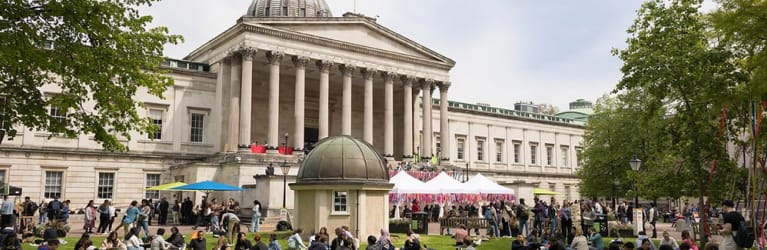
UCL’s location in central London is a huge advantage for study in the mathematical and physical sciences. Collaborations with other institutions are easy, and London is at the centre of world science. Visiting researchers, students and guest lecturers pass through UCL regularly. At the heart of one of the world’s most progressive cities, you’ll be perfectly placed to take advantage of everything London has to offer. UCL provides students with a wealth of services and facilities to meet their cultural, social, and leisure interests as well as their practical needs. Campus life is lively and varied, with a choice of social spaces and a huge variety of events on offer including talks, exhibitions and workshops.

For the majority of our programmes, applications for the 2024/25 academic year open on 16 October 2023. Please check the Graduate Prospectus programme pages for specific application dates.

We know applying for courses can be daunting, so we’ve made this guide to help you through at: https://www.ucl.ac.uk/prospective-students/graduate/taught-degrees/applying-graduate-taught-study-ucl - Please note: you can only apply to a maximum of two taught graduate programmes in any academic cycle.

If you are UK national, Republic of Ireland national, a citizen of a Crown Dependency or have Pre-settled or Settled status you will not require a visa to study at UCL. Most other students will usually require a student visa to study at UCL if they are coming to study in the UK for more than 6 months. However, a number of different UK visas will still allow you to study in the UK so please visit our student visa webpages to check which visa you will need.

The English language requirements for a programme are stated on the programme’s prospectus page. You may be required to meet one of UCL’s five levels of English language proficiency, or obtain specific scores in a UCL-recognised test. UCL’s English language policy details all of the ways in which you can meet the minimum English language requirement for your chosen programme of study.

Applications are considered on a rolling basis and therefore may close earlier than the advertised deadline. We recommend that you submit your application as soon as possible. A programme may remain open after the general deadline (31 March 2024) if places are still available and will be closed as soon as it is full or by 30 June 2024


Main campus

University College London

London

United Kingdom

Courses at Faculty of Mathematical and Physical Sciences